
Greg Isenberg published a sketch last week that has been making the rounds: the five eras of marketing. Mad Men, digital marketer, growth hacker, AI-assisted marketer, and now the marketing engineer. His line under it: the cost of an experiment keeps collapsing.
I looked at it and realized I have worked in every one of those eras. Not studied them. Worked in them. So here is what each one felt like from the inside, and the one era the sketch leaves out.
Era 1: Big ideas, big budgets
I started as a morning show producer at KSBY in San Luis Obispo in 1995, then anchored weekends at KRCR in Redding and reported for FOX40 in Sacramento. In August 1997 the FDA opened the door to drug ads on broadcast TV. Direct-to-consumer drug spending more than doubled in three years, from $791 million in 1996 to $1.85 billion in 1999. We watched the ad breaks fill up.
That was marketing by the quarter. One big idea, one big buy, and you found out months later whether it worked. A 30-second Super Bowl spot cost $2.1 million in 2000. That was one test.
Era 2: Channels and dashboards
I left TV for a PR agency in 2000, the same year Google launched self-serve AdWords with about 350 advertisers. For the first time a click could be counted. By the time Facebook launched ads in 2007, I was doing PR for a mortgage insurer heading straight into the financial crisis. You could run a few experiments a month, if the agency agreed.
Era 3: Loops and sprints
In 2008 I joined eHealth. Sean Ellis named the growth hacker in 2010. Marketers wrote an Agile Marketing Manifesto in 2012. By 2014 we were running two-week marketing sprints across every channel at eHealth, testing messaging in search, TV, email and social on the same clock.
Before that, on October 1, 2013, HealthCare.gov launched. It drew 4.7 million visitors and enrolled six people on the first day. Six. eHealth was a web broker that already knew how to sell individual coverage online, and we were building a content engine at the same time. The lesson stuck with me: budget does not beat speed, and speed does not beat being useful.
That was also where context marketing came from. We wrote a plain FAQ about COBRA. No pitch, just answers. It ranked number one on Google, and every person who read it told us something without filling out a form: they had just lost a job and needed coverage. The content itself identified who was ready to buy. In 2016 I started calling that context marketing.
Era 4: Faster drafts, same org chart
ChatGPT launched on November 30, 2022. Everyone got faster drafts. Most teams kept the same meetings, the same approvals and the same three tests a month.
Era 5: Marketer plus builder
This is the era Greg is describing: one person who can think like a marketer and build like an engineer, running agents that ship dozens of experiments a day. I believe it, because I have watched the cost drop. At Credo we stood up a physician acquisition program in 60 days that reached 40 qualified leads a week at a $120 cost per lead. We produced a monthly AI video newsletter with a stack of six AI tools: Grok, Nano, Mirage, CapCut, ElevenLabs and imagineart.ai.
The era the sketch leaves out
Here is the part healthcare marketers will recognize. One day after ChatGPT launched, on December 1, 2022, HHS told covered entities that tracking pixels could disclose protected health information. Earlier that year, a review found the Meta pixel on the booking pages of 33 of the top 100 US hospitals. In February 2023 the FTC fined GoodRx $1.5 million and banned it from sharing health data for most advertising. In July 2023, the FTC and HHS sent warning letters to about 130 hospital systems and telehealth companies.
I was at Bicycle Health, a telehealth company, when that happened. We had to restart paid acquisition without tracking pixels. Marketing with the lights off.
So in healthcare, the cost of making an experiment collapsed at the same moment the cost of measuring one went up. You can generate a hundred ad variations before lunch. You cannot always see which one worked, and you cannot send patient data anywhere to find out.
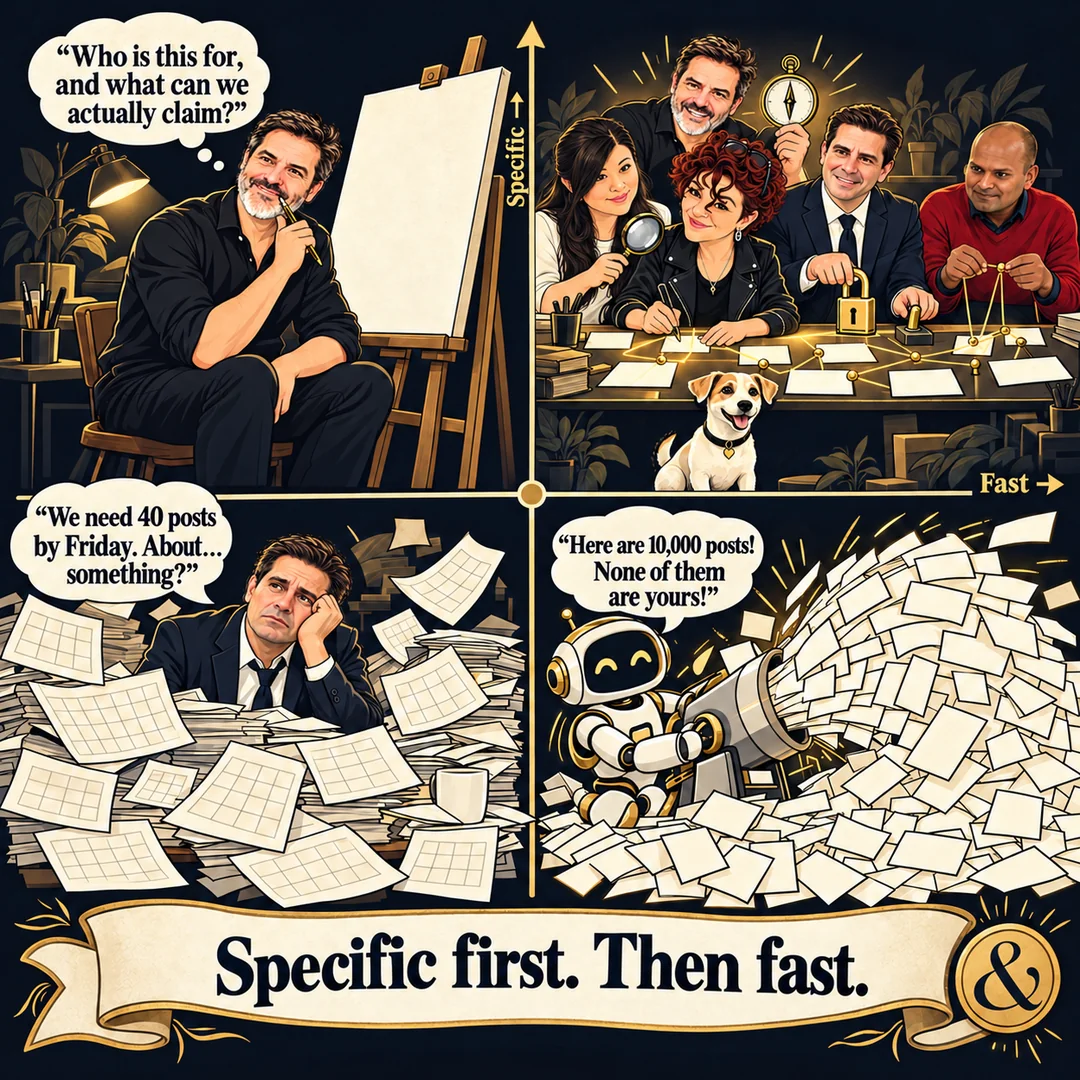
That changes what wins. When you can’t track everything, the only advantage left is knowing your customer well enough that your ideas start out specific. A test built on a vague idea gives you vague results faster. A test built on what patients actually search for at 2 a.m., in their own words, gives you something to learn from even when the dashboard is dark.
A test built on a vague idea gives you vague results faster.
That is the vertical axis on Greg’s other sketch, the one about specificity. It is also what I meant by context marketing in 2016. The tools changed. The job did not: be useful to the right person at the right moment, and let that usefulness tell you who they are.
What I would tell a healthcare team today
- Write down who your customer is before you write a single prompt. Their words, their triggers, their objections.
- Put guardrails in the system, not in a memo. Read-only data first, human approval before anything ships, nothing with patient data in an ad platform.
- Run more tests, but only on specific ideas. More tests only matter if the ideas stay specific.
- Keep a failed-campaigns log. In a regulated category, what didn’t work is your most valuable data.
I have marketed through five eras. The sixth one is the one I care about most: the one where the machines get faster and the humans get more specific.
Sources
- Isenberg, "Marketing Engineers: 100x More Experiments with AI agents" (Oct 8, 2026)
- CRS report RL32853 on DTC advertising
- Google press release, Oct 23, 2000
- Agile Marketing Manifesto history
- ABC News on HealthCare.gov day one
- NativeAI All-Stars Q&A with Nate Purpura (Dec 14, 2016)
- HHS OCR tracking technologies bulletin (Dec 1, 2022)
- The Markup Pixel Hunt (2022)
- FTC GoodRx action (Feb 1, 2023)
- FTC/HHS joint letters (Jul 20, 2023)
— N.