Case study
A salesman goes out on his own, and builds the brand to back him.
Brian Tredway left his company to start his own diesel tuning business, brick by brick. He set up his first website himself on Yahoo’s Turbify. We came in with the research to help him build the next one around how his customers actually buy.
Who we helped
Hillbilly Einstein Performance, a remote diesel tuning business in Akron, Ohio, built on 40 years of combined experience.
The goal
Turn a self-built start into a brand that matches Brian’s reputation and sells the way he does.
What we did
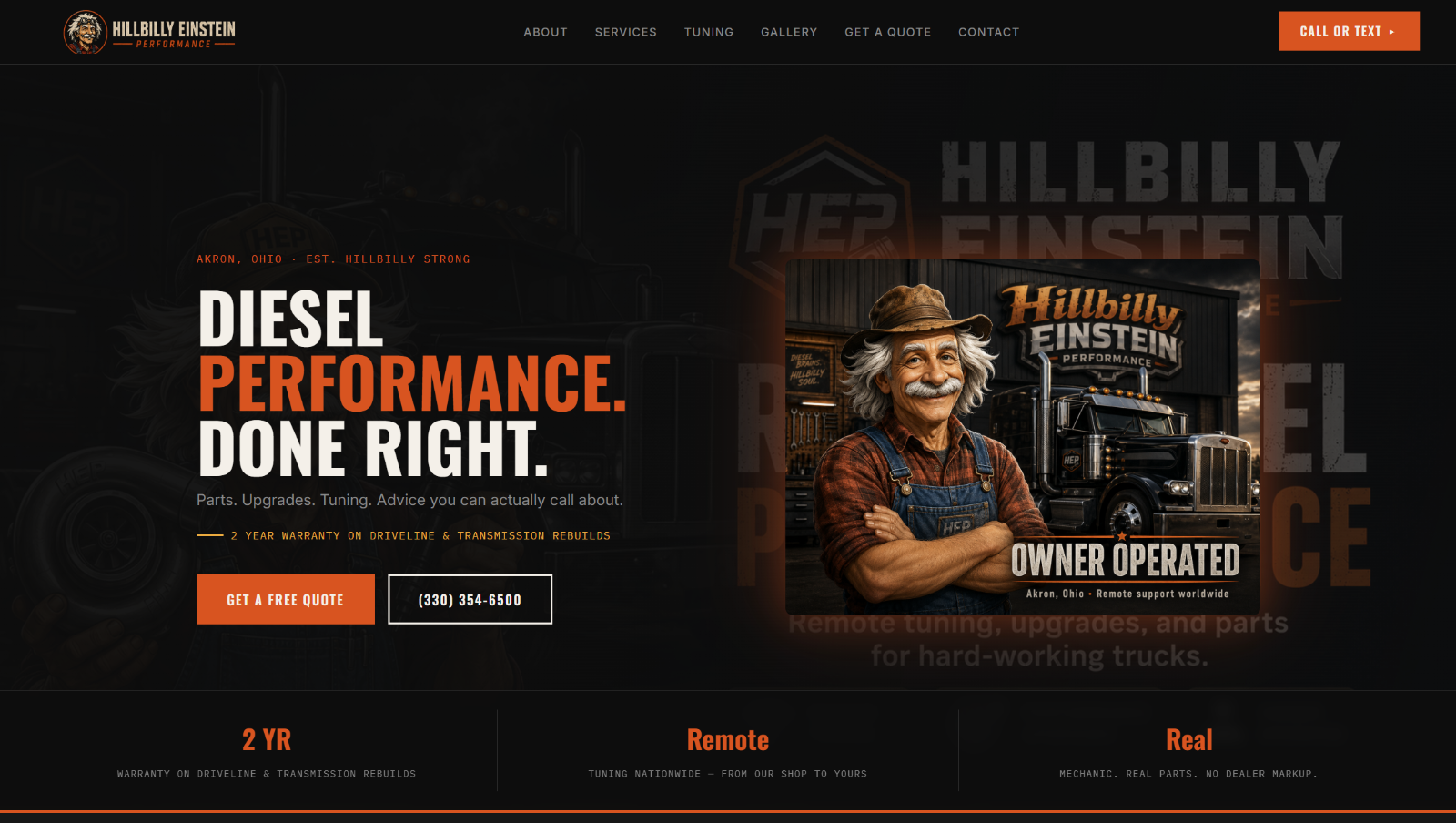
Researched his market and competitors, built a brand around the name he chose and launched a mobile-first site that sends customers to a conversation.
01 · The situation
Built brick by brick
Brian is a salesman at heart. When he decided to leave his company and go out on his own, he set up his first website himself on Yahoo’s Turbify and started taking customers. It got him going.
Full disclosure: Brian and I have known each other since elementary school. He was one of the first people to call when A&I opened.
02 · The work
Research first, then the brand
We started with a deep research brief on his customers, his competitors and how people in his market actually buy. Every decision afterward traces back to it.
The research confirmed that the name he chose was his strongest asset, so we built the brand around it. It also showed how tuning can and can’t be sold online, so every call to action leads to a phone call or a consultation, which is where Brian is at his best.
03 · The outcome
Customers call. Brian sells.
The new site works on a phone, sounds like Brian and gives every visitor one clear next step. He also has a social media plan, a content kit and a simple playbook for keeping the site current.
“Lisa’s known me since we were kids, so she already knew I wasn’t going to want to mess with some fancy dashboard for six hours a day. She built me something I don’t have to think about. Customers call, I do what I’m good at. That’s the whole point.”
Brian Tredway, owner, Hillbilly Einstein Performance